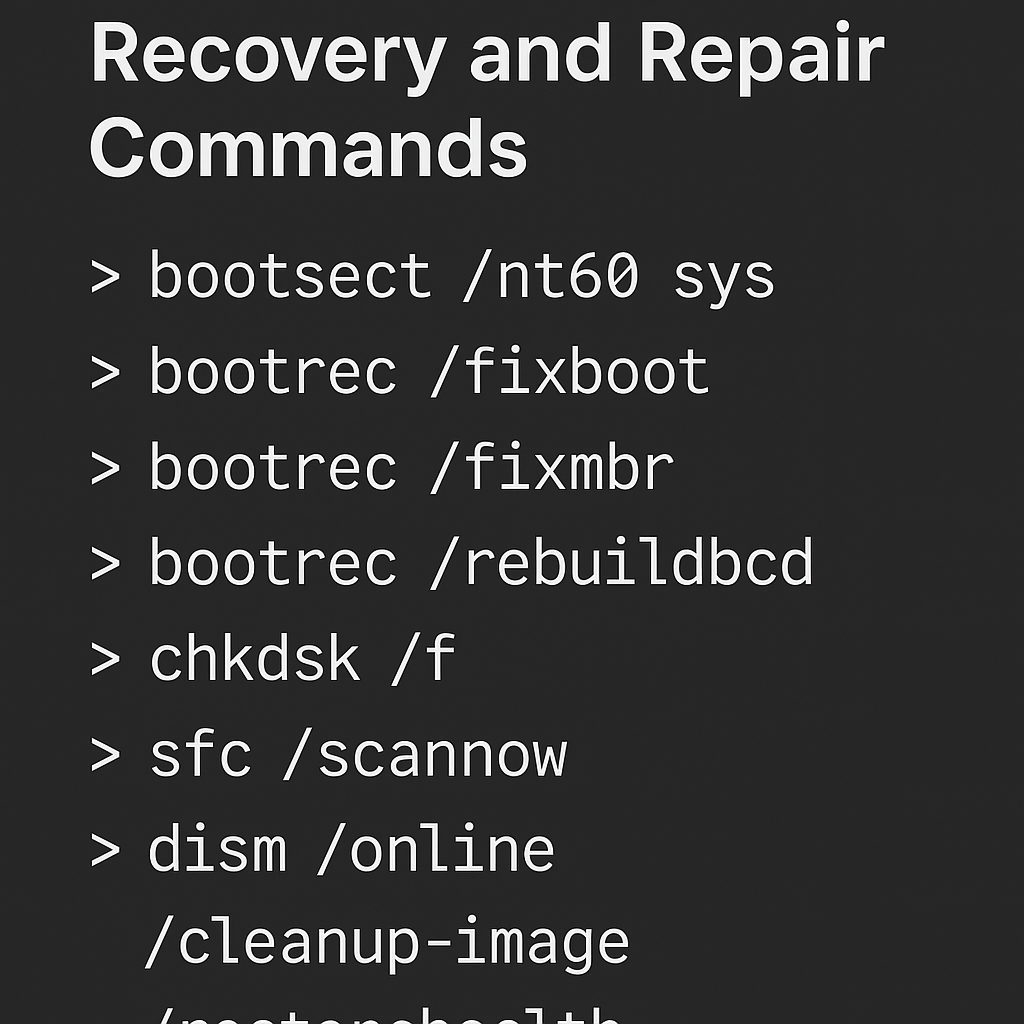
When your Windows 11 system isn't behaving as it should, built-in recovery and repair tools can help fix a variety of issues. Below is a comprehensive list of essential commands every power user and technician should know.
System File Checker (SFC)
The System File Checker scans and attempts to repair corrupted or missing system files.
sfc /scannow
Deployment Imaging Service and Management Tool (DISM)
DISM can check the health of your Windows image and restore missing or damaged files.
DISM /Online /Cleanup-Image /CheckHealth
DISM /Online /Cleanup-Image /ScanHealth
DISM /Online /Cleanup-Image /RestoreHealth
System Reset Options
Use these commands to reset your PC either with a clean install or via the built-in recovery interface.
systemreset -cleanpc        # Resets using a clean Windows image
systemreset                 # Opens the Reset this PC interface
Boot to Advanced Startup Options
Boot into the Windows Recovery Environment (WinRE) for troubleshooting options like Startup Repair.
shutdown /r /o /f /t 0
Boot Configuration Repair
These commands help fix boot-related issues, especially useful after a failed update or drive corruption.
bootrec /fixmbr
bootrec /fixboot
bootrec /scanos
bootrec /rebuildbcd
Check Disk Utility
Checks for disk errors and attempts to fix them.
chkdsk C: /f /r /x
Restore Registry from Backup (From WinRE Command Prompt)
If your registry is corrupted, restore it using backups stored in the RegBack folder.
cd C:\Windows\System32\config
ren DEFAULT DEFAULT.bak
copy C:\Windows\System32\config\RegBack\DEFAULT DEFAULT
copy C:\Windows\System32\config\RegBack\SYSTEM SYSTEM
copy C:\Windows\System32\config\RegBack\SOFTWARE SOFTWARE
By mastering these commands, you can troubleshoot and fix many common Windows 11 issues without relying on third-party tools. Bookmark this page or keep a PDF handy for future use.